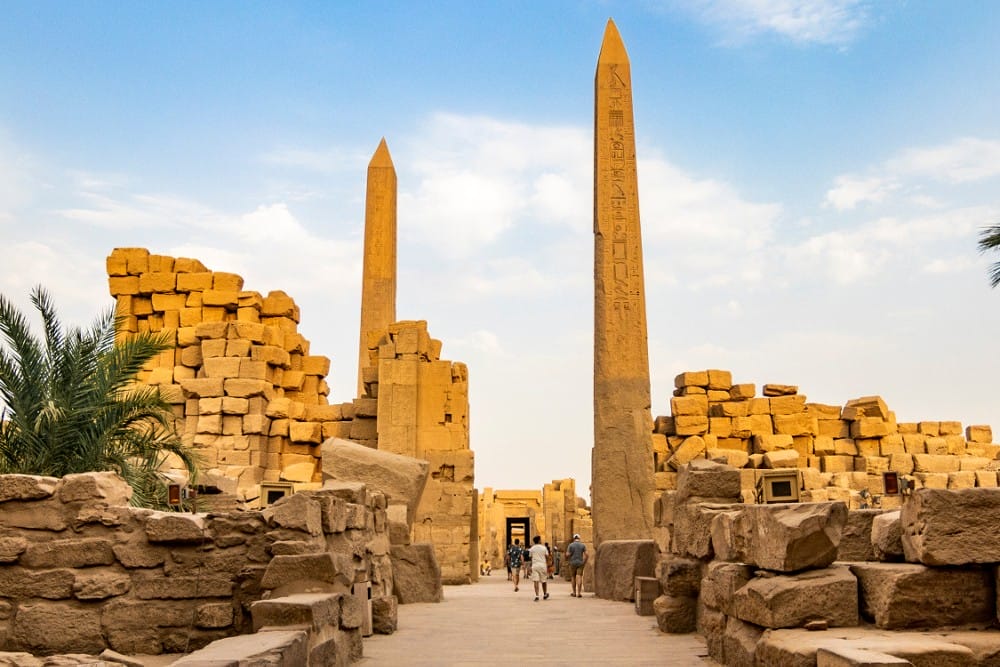
The Hatshepsut Obelisk is a breathtaking 97-foot-tall monolithic pillar carved from a single block of pink Aswan granite, making it the tallest standing ancient obelisk in Egypt today. Located deep within the central core of the massive Karnak Temple Complex in Luxor, this 343-ton architectural marvel represents the absolute peak of New Kingdom engineering. For travelers and history enthusiasts alike, exploring this monument isn’t just about admiring an ancient stone; it is a direct encounter with the political ambition, religious devotion, and sheer willpower of Queen Hatshepsut, one of the most successful female pharaohs to ever rule Egypt.
Commissioned around 1479 BCE during the 18th Dynasty, this colossal structure was raised to mark Hatshepsut’s 16th year on the throne and to solidify her divine right to rule before a traditionally male-dominated society. While most ancient monuments feel distant and detached, walking up to Hatshepsut’s obelisk feels incredibly intimate. As your eyes trace the deeply carved hieroglyphics stretching toward the sky, a powerful question naturally takes hold: How did ancient builders transform a raw block of mountain granite into a flawless, soaring needle of light using nothing but primitive copper chisels, wood, and human muscle?
Where Is the Hatshepsut Obelisk Located in Egypt?
The obelisk is located in Upper Egypt, positioned inside the northern wing of the Karnak Temple Complex in Luxor (the ancient city of Thebes).
[Main Temple Entrance] —> [Great Hypostyle Hall] —> [Hatshepsut Obelisk]
|
Walk to the South: ———+
[Sacred Lake & Fallen Twin]
Specifically, it stands proudly between the Fourth and Fifth Pylons, the monumental stone gateways built by her royal ancestors. Hatshepsut intentionally chose this high-traffic, sacred central axis because it was the main stage for the annual Opet Festival, ensuring that every priest, noble, and visiting diplomat would have to look up at her grand monument.
The Exploration Experience: Walking Through Karnak
When you step out of the shaded forest of columns in the Great Hypostyle Hall, the landscape suddenly opens up, and the Hatshepsut Obelisk immediately dominates your field of vision. Exploring it up close reveals why it has fascinated travelers for centuries.
Standing at the Base
The first thing that hits you when you stand at the foot of the obelisk is its impossible scale. The stone is so perfectly leveled that even after 3,500 years of earthquakes and groundwater shifts, it still stands remarkably straight. If you look closely at the corners, you will notice that the sides are slightly curved outward, an intentional optical illusion created by ancient architects so the pillar wouldn’t look hollow or thin when viewed from directly below.
The Fallen Twin at the Sacred Lake
Your exploration isn’t complete until you take a short walk toward the nearby Sacred Lake. There lies the upper half of Hatshepsut’s second giant obelisk, which collapsed in antiquity.
| [Standing Obelisk] [Fallen Twin](Admire the vertical scale) (Get eye-level with the apex) |
Because it rests horizontally on the ground, this fallen giant offers a rare, eye-level opportunity to study the fine craftsmanship of the pyramidion (the pointed tip). You can easily see the smooth recesses where a heavy cap of glittering electrum (a natural alloy of gold and silver) was once attached to catch the desert sunbeams.
Inscriptions and What They Reveal to the Viewer
The hieroglyphic carvings running down the four faces of the granite are incredibly crisp, deep, and beautifully preserved. Unlike typical royal decrees that read like dry propaganda, the text here offers a remarkably transparent look into Hatshepsut’s mind.
As you follow the columns of text, you are reading a direct appeal to future generations. One of the most famous passages carved near the base reads:
“Now my heart turns this way and that, as I think what the people will say. Those who shall see my monuments in years to come, and who shall speak of what I have done.”
The text explicitly documents the logistics of her achievement, proudly declaring that the entire project, from cutting the stone out of the bedrock in Aswan to erecting it in the heart of Thebes, took a mere seven months. For an ancient reader, this wasn’t just a technical boast; it was proof of divine favor.
Who Was Hatshepsut and Why Did She Build It?
To truly understand the monument’s grand scale, you have to understand the political tightrope Hatshepsut was walking. Originally the chief queen of Thutmose II, she was appointed regent when her husband died, acting as the guardian for her young stepson, Thutmose III.
A Bold Political Move
Instead of remaining a temporary caretaker, Hatshepsut took the unprecedented step of declaring herself full pharaoh. To legitimize her rule in the eyes of a conservative society, she didn’t just rule as a woman; she officially adopted the traditional male titles, regalia, and ceremonial false beard of the kingship.
The Purpose of the Monument
She ordered these massive obelisks for her Sed festival, a sacred jubilee meant to completely rejuvenate a pharaoh’s political power and physical energy. By erecting the tallest pillars in Egypt at the nation’s primary religious sanctuary, she was physically asserting that Amun-Ra, the supreme god, had directly chosen her to hold the crown.
Historical Background of the Obelisk
Hatshepsut’s 22-year reign is remembered by historians as a golden age of peace, domestic stability, and immense economic wealth. Rather than wasting Egypt’s resources on bloody military expansion, she poured the treasury into restoring ancient shrines and launching legendary maritime trade expeditions, most notably to the wealthy African Kingdom of Punt.
The construction of her obelisks was the crowning achievement of this domestic renaissance. While her ancestors had built impressive monuments, Hatshepsut wanted to completely eclipse them by building structures that were taller, heavier, and more brilliantly decorated than anything Karnak had ever seen.
Religious and Symbolic Meaning of the Obelisk
To the ancient Egyptians, an obelisk (called a tekhen) was far more than an impressive marker; it was a living, holy object designed to channel cosmic forces down to the earth.
- Petrified Sunbeams: The tall, tapering shape of the pillar was meant to mimic a physical ray of sunlight bursting through the clouds. Because it reached so high into the sky, its golden tip caught the morning sun long before the ground below became bright, symbolizing the daily victory of light over darkness.
- The Primeval Mound: The small pyramid shape at the very top mirrored the benben, the legendary mound of earth that rose out of the dark, chaotic primordial waters at the dawn of creation.
- Ma’at (Cosmic Order): Standing perfectly straight, the obelisk stood for truth, balance, and cosmic order, the exact concepts a pharaoh was sworn to protect.
Construction and Engineering of the Obelisk
The sheer scale of moving a 343-ton piece of solid granite across hundreds of miles without modern heavy machinery remains one of the greatest engineering triumphs in human history.
Three Stages of Ancient Engineering
| Stage & Location | Key Technical Process | Engineering Secret |
| 1. Quarrying (Aswan Quarries) | Workers smashed deep trenches into the solid bedrock surrounding the granite block using heavy 12-pound dolerite pounding stones until it naturally split free. | Continuous, synchronized physical force using tools harder than granite itself. |
| 2. River Transport (The Nile River) | The monolithic 343-ton block was carefully slid onto a massive wooden cargo barge, which was then towed downriver by a massive fleet of 30 specialized rowing boats. | Timing the journey perfectly with the annual Nile flood season to handle the extreme weight. |
| 3. Erecting (Karnak Temple) | Engineers built a massive enclosed mud-brick ramp around the pedestal, filled it with sand, dragged the stone up, and slowly drained the sand from a release funnel to guide it upright. | Utilizing gravity and sand displacement to lower and balance the monument flawlessly without modern cranes. |
Archaeological Importance of the Obelisk
The standing obelisk at Karnak is an indispensable artifact for modern Egyptology. Because it was made from incredibly durable granite rather than soft limestone or mud-brick, it survived centuries of weather, war, and political shifts that destroyed surrounding buildings.
Furthermore, because it bears extensive text across all four sides, it serves as a linguistic baseline for studying the grammatical structures and vocabulary of the mid-18th Dynasty, providing invaluable context for dating other minor artifacts found within the Nile Valley.
Practical Tips for Visiting the Hatshepsut Obelisk
- Timing is Everything: To see the obelisk the way the ancient Egyptians intended, visit early in the morning, right as the gates open. The low morning sun hits the upper granite first, creating a brilliant, glowing effect against the sky.
- Bring a Monocular or Zoom Lens: The finest, most intricate hieroglyphic details are carved near the upper half of the 97-foot pillar. A small zoom lens will let you admire the precise, clean cut of the ancient chisels.
- Hire an Expert Guide: Karnak is an overwhelming labyrinth of stone. Utilizing renowned, specialist travel operators like archaeologicalpaths ensures you bypass the crowds and explore these hidden historical details with a professional Egyptologist guiding your path.
FAQs
Where exactly is the Hatshepsut Obelisk located?
It is located in Luxor, Egypt, standing inside the central core of the Karnak Temple Complex between the Fourth and Fifth Pylons.
How much does the Hatshepsut Obelisk weigh?
The monumental pillar is carved from a single piece of pink granite and weighs approximately 343 tons.
Why did Hatshepsut build this monument?
She raised it to commemorate her Sed festival (royal jubilee), to celebrate her 16th year on the throne, and to publicly cement her divine legitimacy as a female pharaoh.
Why is the second obelisk lying on the ground?
The second obelisk collapsed in antiquity due to a severe earthquake. Its upper portion is now on display safely near the Sacred Lake inside the Karnak complex.
Conclusion
The Hatshepsut Obelisk is one of the best examples of ancient Egyptian art and engineering. From its start in the rocky quarries of Aswan to its preservation behind the walls of a rival, it tells an unforgettable story of survival and power. Seeing it up close is an experience you will never forget.