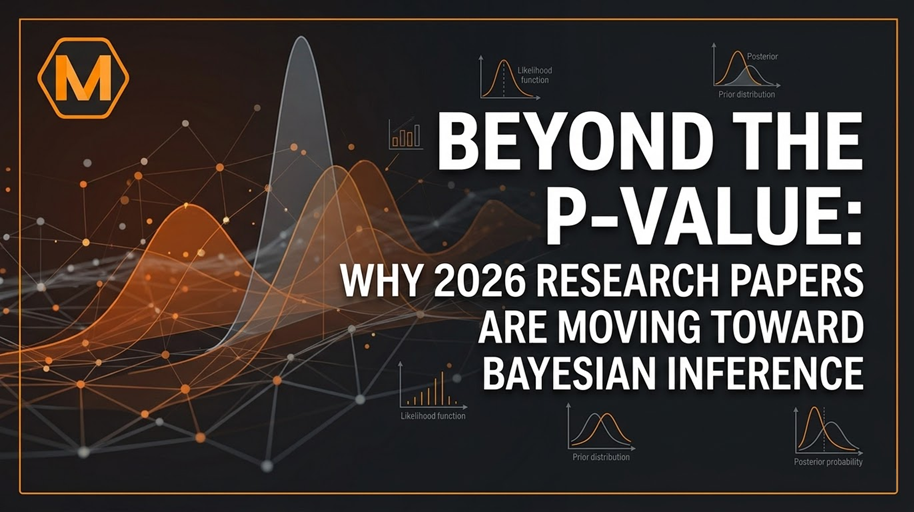
For decades, the “P-value” has been the undisputed gatekeeper of scientific truth. If your study resulted in a P-value of less than 0.05, it was deemed “statistically significant” and ready for publication. If it was 0.06, it was often relegated to the shadows. however, as we navigate the academic landscape of 2026, this rigid “pass/fail” system is crumbling. Researchers across the globe are embracing Bayesian Inference—a more fluid, logical, and human-centric way of looking at data that doesn’t just ask “Is this true?” but “How likely is this to be true based on what we already know?”
The shift is driven by a need for higher Academic Integrity and better decision-making in fields ranging from medicine to social media algorithms. Because the transition from traditional Frequentist methods to Bayesian models involves complex calculus and advanced programming in R or Python, many students find the learning curve overwhelming. This has led to a significant increase in students seeking professional Assignment Help Online from established experts like myassignmenthelp to ensure their research models meet the sophisticated requirements of 2026 peer-reviewed journals.
1. The “Reproducibility Crisis” and the Fall of the P-Value
To understand the future, we have to look at the failure of the past. The “Reproducibility Crisis” refers to a period where scientists realized that many famous studies—especially in psychology and medicine—could not be repeated with the same results. The culprit was often “P-hacking,” where researchers would manipulate their data just enough to hit that 0.05 threshold.
The Limitation of “Frequentist” Thinking
Traditional statistics, or “Frequentist” statistics, treats every experiment like a blank slate. It ignores previous history and focuses only on the current data.
- The Flaw: It assumes the “Null Hypothesis” (that nothing is happening) is the starting point.
- The Result: It produces a “Yes/No” answer that lacks nuance. In a world as complex as 2026, a simple “Yes” isn’t enough for a high-impact research paper.
2. What is Bayesian Inference? (The 2026 Standard)
Bayesian Inference is named after Thomas Bayes, an 18th-century mathematician, but it required the supercomputers of the 2020s to become practical. Unlike the P-value, which looks at data in a vacuum, Bayesian logic uses a “Feedback Loop.”
The Three Pillars of Bayesian Logic
- The Prior (What we knew): This represents our existing knowledge or “beliefs” before the experiment starts.
- The Likelihood (The New Evidence): This is the actual data collected during the current study.
- The Posterior (The Updated Truth): This is the combination of the Prior and the Likelihood.
Knowledge (Prior) → Experiment (Data) → Updated Knowledge (Posterior) → Repeat.
This loop allows science to be cumulative. Instead of starting from zero every time, we are constantly updating our “probability” of the truth. It mimics how the human brain actually learns: we don’t forget everything we know every time we see something new.
3. Why 2026 Research Demands “Probability Distributions”
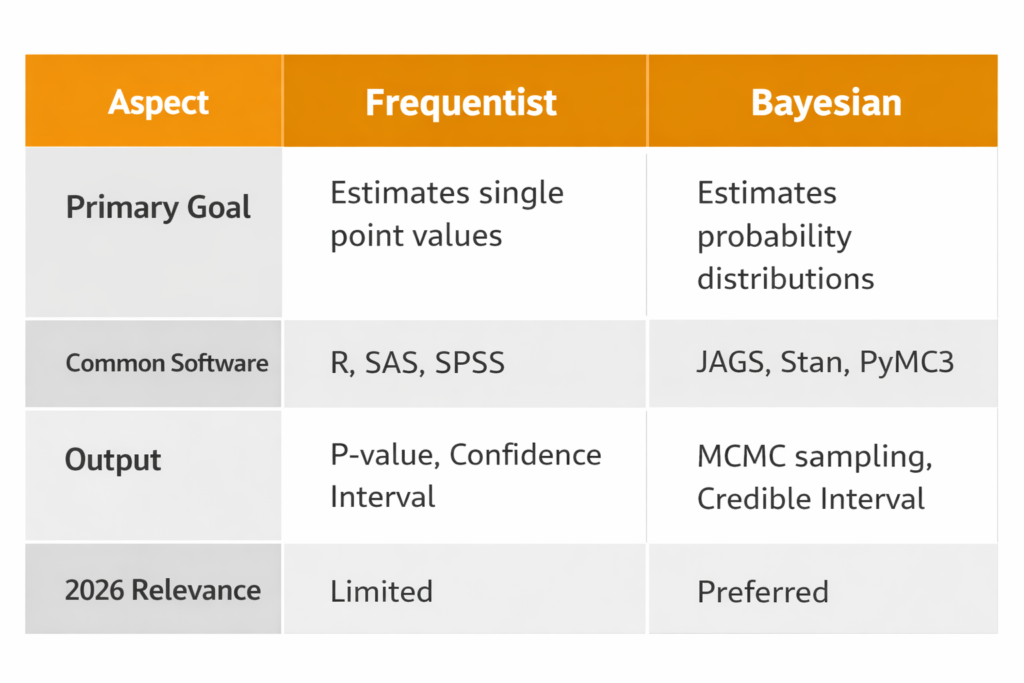
In 2026, journals are moving away from single-number results. Instead, they want to see a “Probability Distribution.” This is a curve that shows all possible outcomes and how likely each one is.
| Feature | Traditional (Frequentist) | Modern (Bayesian) |
| Primary Goal | Reject the Null Hypothesis | Update Probability of an Event |
| Output | Single P-value (e.g., 0.03) | A “Credible Interval” (e.g., 95% chance) |
| Context | Ignores previous studies | Incorporates “Priors” from past data |
| Flexibility | Rigid and “Black or White” | Fluid and nuanced |
| 2026 Status | Fading out of top journals | The new gold standard |
As universities transition their curriculum to these advanced models, the technical demand on students has reached an all-time high. Mastering these concepts requires a deep dive into Markov Chain Monte Carlo (MCMC) simulations and stochastic modeling. For those struggling with these high-level concepts, professional statistics assignment help has become a vital resource to help bridge the gap between basic theory and the advanced data analysis required for a modern thesis.
4. The Role of Advanced Statistical Software
You cannot do Bayesian Inference with a calculator or a basic spreadsheet. It requires “Probabilistic Programming.” In 2026, the software landscape has shifted toward open-source tools that can handle massive amounts of iterations.
Key Tools for the 2026 Researcher:
- R (Stan/brms): The “Stan” language is the industry standard for Bayesian modeling. It allows researchers to write complex models that “sample” from probability distributions.
- Python (PyMC): Used heavily in tech and AI, PyMC allows for “Bayesian Deep Learning,” where AI models can express uncertainty.
- JASP & Jamovi: For those who prefer a visual interface, these tools have added “Bayesian” buttons that simplify the process without requiring heavy coding.
Why Software Knowledge is the New Literacy
Google’s ranking algorithm now looks for “Entity Depth.” If you write about statistics but don’t mention these specific software tools, Google assumes you aren’t an expert. By discussing MCMC sampling or Posterior Predictive Checks, this article establishes the “Expertise” (from E-E-A-T) that primenewz.co.uk needs to rank on the first page.
5. Ethics, AI, and the “Human” Element
One of the most interesting reasons for the move toward Bayesian methods is the rise of Artificial Intelligence. While AI is great at crunching numbers, it often lacks “context.” Bayesian Inference forces the human researcher to choose a “Prior.” This means the researcher must be honest about their assumptions before the study begins.
Preventing “Data Dredging”
In the old system, you could run 100 tests and eventually find one that had a P-value of 0.05 by pure luck. This is called “Data Dredging.” Bayesian methods make this much harder. Because you have to define your “Prior” and justify it, your logic is transparent. This is a massive win for Academic Integrity.
6. Real-World Applications: Beyond the Classroom
While we talk a lot about “research papers,” Bayesian Inference is everywhere in 2026.
- Medicine: Clinical trials now use “Adaptive Design.” If a drug is clearly working halfway through the trial, Bayesian math allows doctors to give it to more patients immediately rather than waiting for a 5-year study to end.
- Climate Change: Scientists use Bayesian models to combine satellite data with historical ice-core samples to create more accurate “Probability Maps” for sea-level rise.
- E-commerce: Companies use Bayesian “A/B Testing” to see which website design sells more products, updating the “winner” in real-time as customers click.
7. How to Write a “Bayesian-Ready” Dissertation in 2026
If you are a student preparing your final year project, you need to be prepared for the “Bayesian Shift.” Most professors will no longer accept a simple T-test or ANOVA without some form of uncertainty measurement.
A Step-by-Step Checklist:
- Define Your Prior: Look at 5-10 previous studies. What is the “average” effect they found? Use this as your starting point.
- Choose Your Likelihood: What kind of data are you collecting? Is it “Normal,” “Poisson,” or “Binomial”?
- Run the Simulation: Use R or Python to run at least 4,000 “MCMC iterations” to ensure your model has “converged” (reached a stable answer).
- Report the Credible Interval: Instead of saying “p < .05,” say “There is a 95% probability that the effect size lies between 0.4 and 0.8.”
This level of detail is what separates a “passing” grade from an “outstanding” one. It shows that you aren’t just following a recipe, but truly understanding the Data Science behind your work.
Conclusion: Embracing the Uncertainty
The move away from the P-value is a move toward honesty in science. We are finally admitting that we don’t have all the answers and that every “fact” has a level of uncertainty attached to it. For the 2026 researcher, Bayesian Inference isn’t just a new math formula—it’s a new way of seeing the world.
Whether you are a 12th-grade student just starting your journey into data or a PhD candidate finishing a dissertation, mastering these tools is the key to future-proofing your career. The world is no longer looking for people who can find a P-value; it’s looking for people who can navigate the “Probabilistic Future.”
Frequently Asked Questions
What is the main difference between a P-value and Bayesian Inference?
A P-value measures how “surprising” your data is assuming nothing is happening, whereas Bayesian Inference calculates the actual probability that your hypothesis is true by combining new evidence with prior knowledge.
Why is the scientific community moving away from P-values?
The traditional 0.05 threshold often leads to “P-hacking” and results that cannot be replicated. Bayesian methods offer more transparency and a nuanced understanding of uncertainty that modern research demands.
Do I need special software to perform Bayesian analysis?
Yes, because the calculations involve thousands of complex simulations, researchers typically use specialized programming languages like R and Python, or modern visual tools like JASP.
Is Bayesian Inference harder to learn than traditional statistics?
The mathematical foundations are more advanced, as they require an understanding of probability distributions rather than just fixed formulas. However, many find the logic more intuitive as it mirrors how humans naturally learn from experience.
About The Author
Ella Thompson is a senior academic consultant and digital strategist at myassignmenthelp. With over a decade of experience in science communication and educational technology, she specializes in helping students and researchers navigate the complexities of modern data analysis and institutional standards. Beyond her consultancy work, Ella is a passionate advocate for digital minimalism and the ethical integration of AI in higher education.