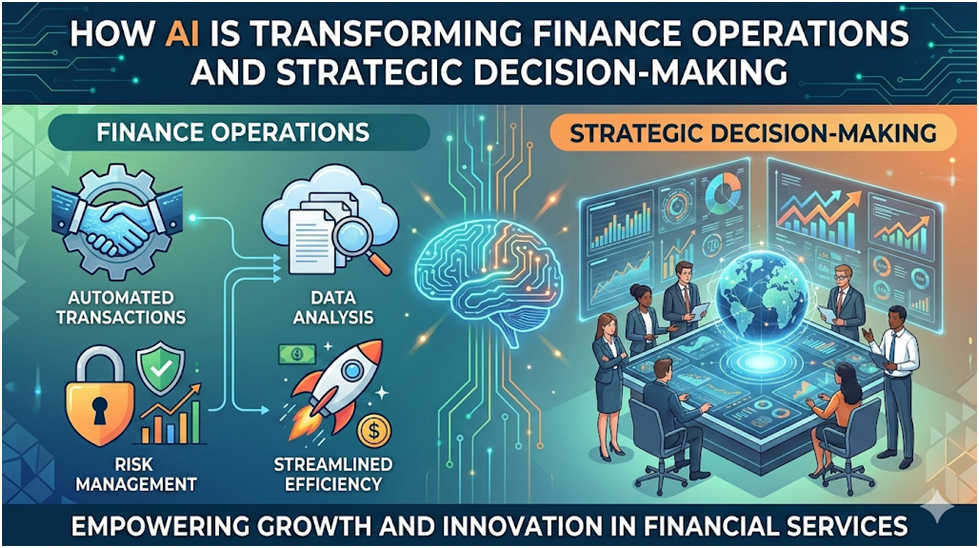
Artificial intelligence is rapidly becoming a strategic enabler for finance organizations seeking to improve efficiency, strengthen decision-making and support enterprise growth. As business environments grow more complex, finance leaders are under increasing pressure to deliver faster insights, reduce operational costs and enhance forecasting accuracy. Traditional processes built around manual analysis and fragmented data are no longer sufficient to meet these demands.
AI technologies are helping finance teams modernize their operating models by automating routine activities, improving data analysis and enabling more predictive capabilities. Many organizations are integrating AI initiatives within broader Finance Transformation programs designed to improve agility, digital capabilities and performance outcomes.
As adoption accelerates, finance leaders are exploring how AI can support core financial processes such as planning, reporting, compliance and risk management. When implemented strategically, AI helps finance evolve from a transactional function into a more strategic partner that drives enterprise value.
Overview of AI in finance
Artificial intelligence in finance refers to the use of advanced algorithms, machine learning models and data-driven systems to automate processes, analyze financial information and generate insights that support decision-making. These technologies are designed to process large volumes of structured and unstructured data quickly and accurately, enabling finance teams to operate more efficiently.
AI capabilities are expanding rapidly across the finance function. They include predictive analytics, intelligent automation, anomaly detection and natural language processing for financial reporting and analysis. When integrated with enterprise systems, AI helps finance organizations streamline workflows and improve visibility into financial performance.
The strategic role of AI in Finance continues to grow as organizations recognize its ability to enhance productivity and strengthen financial insights. Rather than replacing finance professionals, AI augments their capabilities by reducing manual work and enabling more advanced analysis.
In modern finance environments, AI technologies can support multiple areas including:
- Financial planning and forecasting
- Risk and compliance monitoring
- Accounts payable and receivable processes
- Financial reporting and analysis
- Fraud detection and prevention
These capabilities allow finance teams to focus less on transactional tasks and more on strategic activities that influence business outcomes.
Benefits of AI in finance
Improved operational efficiency
One of the most significant benefits of AI in finance is the ability to automate repetitive tasks that traditionally require extensive manual effort. Processes such as invoice processing, reconciliation and data validation can be completed faster and with greater accuracy using AI-powered tools.
Automation reduces the time spent on routine work and allows finance professionals to concentrate on activities that create higher value for the organization. This shift improves productivity while also reducing operational costs.
Enhanced data-driven insights
Finance leaders rely on accurate and timely information to support strategic decision-making. AI systems can analyze large datasets in real time, identify patterns and generate insights that might otherwise be difficult to detect.
These capabilities improve forecasting accuracy, support scenario analysis and enable finance teams to provide more strategic guidance to business leaders.
Faster financial reporting
Financial reporting cycles often involve complex data collection and reconciliation across multiple systems. AI technologies streamline these processes by automatically aggregating data and identifying inconsistencies.
As a result, organizations can accelerate reporting timelines while improving the reliability of financial information. Faster reporting enables leadership teams to respond quickly to changing market conditions.
Improved risk management
Risk management is a critical responsibility within the finance function. AI tools can analyze transaction patterns, identify anomalies and detect potential fraud more effectively than traditional rule-based systems.
By continuously monitoring financial activities, AI helps organizations strengthen internal controls and reduce exposure to financial risk.
Better compliance and regulatory oversight
Finance teams operate in environments that require strict adherence to regulatory requirements. AI can assist with compliance monitoring by reviewing financial transactions, identifying irregularities and generating documentation that supports audit processes.
These capabilities help organizations maintain transparency and ensure adherence to evolving regulatory standards.
Use cases of AI in finance
Financial planning and analysis
Predictive forecasting
AI models can analyze historical financial data alongside market indicators to produce more accurate forecasts. Predictive forecasting helps organizations anticipate revenue trends, manage budgets more effectively and plan for potential economic changes.
Scenario analysis
Finance teams can use AI tools to evaluate multiple business scenarios and assess their financial implications. This enables leadership to make informed decisions based on data-driven insights.
Accounts payable and receivable automation
Intelligent invoice processing
AI technologies can automatically extract information from invoices, validate data and route documents for approval. This reduces processing time and minimizes errors associated with manual data entry.
Automated payment reconciliation
AI systems can match transactions with corresponding payments, identify discrepancies and streamline reconciliation processes. This improves financial accuracy and reduces administrative workload.
Fraud detection and financial risk monitoring
Transaction anomaly detection
AI algorithms can analyze financial transactions to detect unusual patterns that may indicate fraud or unauthorized activity. Continuous monitoring enhances security and enables faster response to potential threats.
Risk assessment models
Finance organizations can use AI to assess credit risk, evaluate supplier reliability and monitor financial exposure across global operations.
Financial reporting and compliance
Automated report generation
AI systems can compile financial data from multiple sources and generate reports that summarize key metrics and performance indicators. This capability reduces the time required to prepare reports and ensures consistency across reporting cycles.
Regulatory compliance monitoring
AI tools can analyze regulatory requirements and monitor financial activities to ensure adherence to compliance standards. Automated alerts help finance teams address issues before they escalate.
Strategic decision support
Data-driven insights for leadership
AI-driven analytics platforms can transform complex financial data into actionable insights that support strategic planning and investment decisions.
Performance benchmarking
AI can compare financial performance metrics against industry benchmarks, helping organizations identify improvement opportunities and measure progress toward strategic goals.
Why choose The Hackett Group® for implementing AI in finance
Successfully deploying AI within the finance function requires a structured approach that combines technology expertise with deep operational insights. The Hackett Group® brings a research-driven perspective that helps organizations implement AI initiatives aligned with measurable performance improvements.
The Hackett Group® is widely recognized for its extensive benchmarking research and its Digital World Class® performance framework. These insights provide organizations with a clear understanding of how leading finance teams achieve superior efficiency, cost performance and strategic impact.
Benchmark-driven transformation strategies
By leveraging benchmarking data from global enterprises, The Hackett Group® helps finance leaders identify performance gaps and prioritize AI initiatives that deliver the most significant business value. This data-driven approach ensures that AI investments are aligned with strategic objectives.
Structured implementation and governance
AI adoption requires strong governance frameworks to manage data quality, security and compliance risks. The Hackett Group® provides guidance on establishing governance structures that support responsible and sustainable AI deployment.
Integrated finance operating model transformation
AI technologies deliver the greatest value when integrated into broader finance operating models. The Hackett Group® helps organizations redesign processes, workflows and organizational structures to fully leverage AI capabilities.
Accelerating AI adoption with advanced platforms
The Hackett AI XPLR™ platform helps organizations explore, evaluate and prioritize AI opportunities across the finance function. By providing structured insights and practical guidance, the platform enables finance leaders to move from experimentation to scalable implementation.
Through a combination of benchmarking insights, strategic advisory services and practical implementation support, The Hackett Group® helps organizations adopt AI in a disciplined and value-driven way.
Conclusion
Artificial intelligence is reshaping the finance function by enabling automation, improving financial insights and strengthening risk management capabilities. As organizations face increasing complexity and competitive pressure, AI provides the tools needed to modernize finance operations and deliver faster, more accurate decision support.
From predictive forecasting to automated compliance monitoring, AI technologies are helping finance teams operate more efficiently while contributing greater strategic value to the business.
However, achieving these benefits requires more than deploying new technologies. Organizations must integrate AI into broader transformation initiatives, establish governance frameworks and align investments with measurable outcomes.
With a structured approach and expert guidance, finance leaders can successfully harness AI to enhance performance, improve decision-making and position the finance function as a strategic driver of enterprise success.